What the Quiet Deals Are Telling You: Reading the Hidden Signals in a Stalled Pipeline
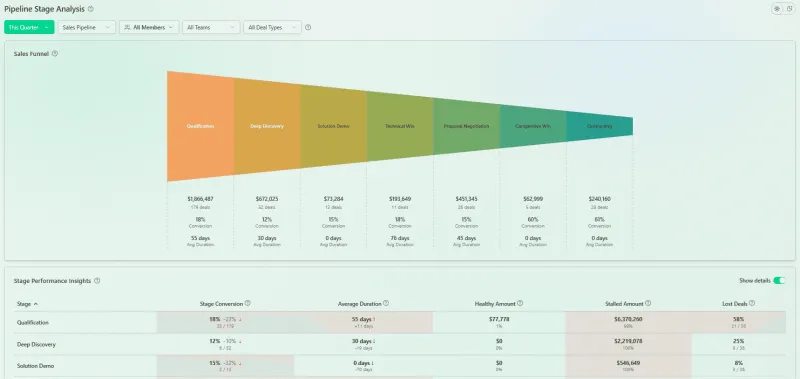
Photo: sales professional analyzing pipeline data on computer screen with declining engagement charts, via framerusercontent.com
The most revealing conversations in sales are often the ones that never happen.
A prospect who was engaged on the discovery call and then went dark. A proposal that was received warmly and never formally declined. A champion who used to respond within hours and now takes days — or does not respond at all. These are not random occurrences. They are data points, and the sales professionals who learn to interpret them systematically hold a significant advantage over those who treat silence as mere friction to be overcome.
The prevailing instinct in sales, reinforced by most training programs and CRM workflows, is to respond to non-response with more contact. Send a follow-up. Try a different channel. Adjust the subject line. There is a time and place for persistence, but when it is applied indiscriminately to every stalled deal, it masks information that the pipeline is actively trying to surface.
Silence Is Not Uniform
The first principle of reading pipeline silence is that not all silence means the same thing. A prospect who stops responding after receiving a pricing proposal is communicating something fundamentally different from a prospect who disengages immediately after a demo or goes quiet before a contract is even discussed.
Timing is one of the most important contextual factors in this analysis. When in the sales cycle does the silence occur? Silence at the proposal stage frequently indicates a pricing or value misalignment — the prospect has the information they need to make a comparison, and the comparison is not favoring your offering. Silence during the evaluation phase often points to an internal process stall: budget approval, stakeholder alignment, or a competing priority that has temporarily displaced your deal.
Early-stage silence — when a prospect disengages after an initial meeting or after receiving a piece of content — can be one of the most instructive signals of all. It may indicate that the problem your solution addresses is not actually a priority for that organization at this moment, regardless of what was communicated during the initial conversation.
The Competitive Intelligence Hiding in Your CRM
When multiple deals in a specific segment or vertical begin going silent at the same stage, the pattern deserves serious attention. Individual deal stalls can be attributed to any number of idiosyncratic factors. But a cluster of stalls — particularly when they involve similar company profiles, deal sizes, or use cases — is often a leading indicator of something more systemic.
Consider what this pattern might reveal. A wave of proposal-stage stalls in a particular industry vertical could indicate that a competitor has introduced new pricing, a new feature set, or a new positioning strategy that is shifting buyer expectations. A pattern of early-stage disengagement from a specific company size tier might suggest that your current messaging is not resonating with the economic realities of that segment.
Sales technology platforms, including modern CRM systems and revenue intelligence tools, are increasingly capable of surfacing these patterns automatically. But the interpretation still requires human judgment. A sales leader who reviews aggregate pipeline data with the specific intention of finding silence patterns — not just activity metrics — is asking a fundamentally different set of questions than one who is simply tracking deal progression.
The Unanswered Email as a Pricing Signal
Pricing perception is one of the most common drivers of sudden disengagement, and it is also one of the least discussed. Buyers in the United States have access to more competitive pricing information than at any previous point in the history of B2B commerce. Peer review platforms, vendor comparison sites, and informal professional networks mean that a prospect often has a working sense of market pricing before they ever speak with your team.
When a prospect's engagement drops sharply after receiving a proposal, the instinct to follow up with value reinforcement is understandable. But before defaulting to that response, it is worth considering whether the silence is communicating something specific about how your pricing landed relative to their expectations or their alternatives.
Some organizations have found that a direct, low-pressure outreach — not a follow-up pitch, but a genuine inquiry into whether the proposal raised any questions about fit or investment — produces more actionable information than multiple rounds of unanswered value-based follow-ups. The goal is to create an opening for the prospect to share what they are actually thinking, rather than to overwhelm them into a response.
What Champions Stop Saying
Internal champions — the advocates within a prospect organization who are invested in your solution moving forward — provide some of the most reliable real-time intelligence available to a sales team. When a champion who was previously vocal and engaged becomes quieter, that shift in behavior is worth investigating before the deal formally stalls.
A champion going quiet does not necessarily mean they have lost interest. It may mean they are navigating internal resistance and do not yet have the standing to communicate openly. It may mean a budget conversation went differently than expected. It may mean a new stakeholder has entered the evaluation process and shifted the internal dynamics.
The skill here is in maintaining a relationship with the champion that allows for candid communication about internal developments. This is not about extracting intelligence — it is about being a resource and a partner to someone who is trying to advocate for a solution they believe in. When that relationship is strong, champions are far more likely to share the organizational context that explains their silence.
Building a Silence-Aware Pipeline Review
Most pipeline reviews are structured around activity: what happened last week, what is scheduled next week, and where deals are in the stage progression. A silence-aware pipeline review adds a second layer of inquiry: where is engagement declining, and what does that pattern suggest about deal health, market conditions, or competitive positioning?
This requires sales leaders to create space for qualitative interpretation alongside quantitative reporting. A deal that has not moved stages but has seen a measurable decline in prospect-initiated contact is a different risk profile than a deal that is simply moving slowly. The CRM stage may look identical. The actual deal trajectory may not be.
Organizations that build this analytical discipline into their regular operating cadence develop a compounding advantage. They identify competitive threats earlier. They surface pricing objections before they become deal-killers. They recognize market shifts in the aggregate data before those shifts register in closed-lost reports.
The pipeline is always communicating. The question is whether your team is equipped to listen — not just to what prospects say, but to what they have conspicuously chosen not to say.